
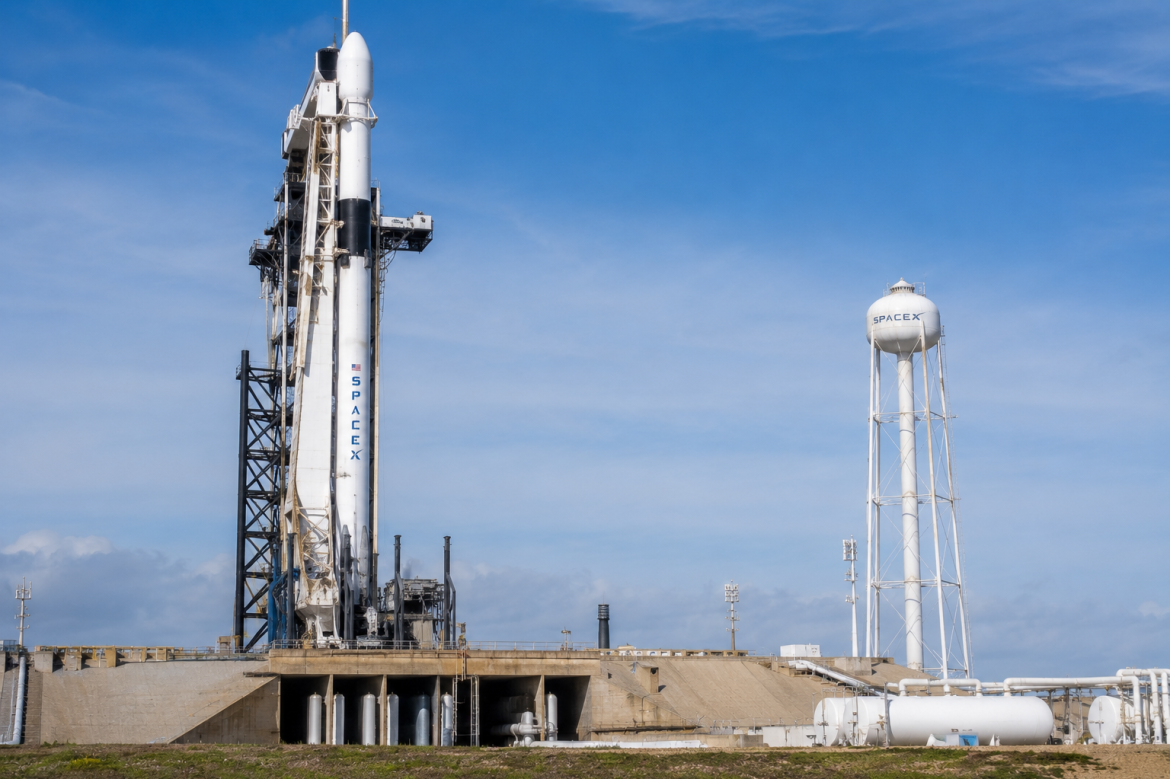
SpaceX shares SPCX are hovering near their opening price now, erasing all of the gains made after the company’s blockbuster stock market debut.
The stock fell as investors look past the boost from its inclusion in the Nasdaq-100 and instead focus on lofty valuations, broader market weakness, and concerns over elevated expectations.
The stock touched an intraday low of $149 on Wednesday shortly after the opening bell before recovering to trade around $150.72 by mid-morning.
Even with the rebound, shares remained close to their debut price of $150 and about 50% below the post-listing peak of $226 reached earlier.
They are still higher than the stock’s IPO price of $135.
SpaceX’s addition to the Nasdaq-100 was expected to generate fresh buying demand as exchange-traded funds and index funds tracking the benchmark adjusted their portfolios to include the stock.
Instead, the shares fell more than 6% on Tuesday.
To be sure, the weakness on Wednesday also came as growing concerns over heavy AI spending, rising US Treasury yields, elevated oil prices and escalating geopolitical tensions in the Middle East weighed on the broader technology sector as well.
Several semiconductor companies, including Micron Technology and Advanced Micro Devices, also posted sharp declines during Wednesday’s session.
“There’s nervousness about expectations being too high,” said Mark Hackett, chief market strategist for Nationwide, in a Reuters report.
“I expect that to continue until we get some earnings out.”
Some market watchers also argued that the decline was not unusual following the initial excitement surrounding a major IPO.
After an early rush of buying, investors often reassess whether a company’s valuation is justified by its financial performance and long-term prospects.
However, the simultaneous decline in both the stock price and trading volume suggests investors may be becoming more selective after the initial enthusiasm.
Wall Street remains overwhelmingly bullish
Despite the recent weakness, SpaceX continues to enjoy broad support from Wall Street.
Ahead of the company’s inclusion in the Nasdaq-100, nearly every major investment bank initiated coverage with bullish recommendations.
Eighteen of the nineteen firms covering the company assigned Buy ratings, with most price targets well above $200.
JPMorgan Chase began coverage with an Overweight rating and a $225 price target.
“SpaceX’s ambitions — and potential impact on humanity — are bigger than any company’s we’ve ever seen,” analysts wrote.
“While SpaceX has already reached a $2T+ market cap post its IPO, we believe significant upside potential remains as the company quite literally builds out the next frontier.”
Morgan Stanley was even more optimistic, assigning an Overweight rating and a $300 target price.
“SpaceX combines near-monopoly launch economics, the world’s largest LEO satellite network, and a fast-scaling AI infrastructure business,” analysts wrote.
“We see the company as one of the few platforms that can link real estate in orbit, global connectivity, and compute capacity into one infrastructure stack.”
Goldman Sachs also initiated coverage with a Buy rating and a $205 target.
“We see the company as well positioned to scale its differentiated advantages across space (launch & reusability), connectivity (broadband & mobile satellite constellation) and AI (compute, X, etc.) — with each of these markets having the potential to become multiple trillion-dollar opportunities over a 5+ year time horizon,” the brokerage said.
Other firms including Bernstein, RBC Capital Markets, Macquarie and UBS also issued bullish recommendations, with price targets comfortably above current trading levels.
One firm breaks from the consensus
The lone exception came from MoffettNathanson.
Analyst Julie Zhu assigned a Neutral rating and a 12-month target price of $131, making it the only major brokerage with a target below the stock’s recent trading price.
While the firm questioned the company’s valuation, its report stopped short of taking an outright bearish stance.
Among its concerns were what it described as an overly ambitious estimate of SpaceX’s addressable market, optimistic assumptions surrounding
Starlink’s satellite-to-phone business and doubts over Elon Musk’s plans to deploy massive computing infrastructure into space.
However, the brokerage also acknowledged several competitive strengths.
It noted that SpaceX effectively enjoys a monopoly in commercial launch services, with Blue Origin still years behind in terms of execution.
The report also described the launch business as the “flywheel that makes SpaceX work,” highlighting the company’s cost advantage in placing satellites into orbit and supporting the economics of Starlink.
Is SpaceX a buy at current levels?
The sharp pullback has investors wondering if it is a good level to buy the stock at.
David Jagielski of The Motley Fool argued that investors should remain cautious despite the company’s ambitious vision.
“This is, after all, an unprofitable company, and while it has grand visions for travel to Mars and putting data centers into space, those are highly ambitious objectives that may take many years to become reality, assuming the company can come through on them at all,” he wrote.
“SpaceX is the only stock that has a $2 trillion valuation or more, and that doesn’t have a highly profitable and successful business. That math on its valuation just doesn’t work, and investors who buy without taking that into consideration could incur mammoth losses. The stock’s decline may just be getting started,” he added.
Research firm Zacks echoed similar concerns, saying much of the company’s long-term growth story already appeared to be reflected in its valuation.
“Even after the recent pullback, investors are still paying a steep price for future growth that will take years to materialize,” the firm said.
Zacks said existing shareholders could continue holding the stock through near-term volatility, noting that Wall Street’s average price target still implies roughly 35% upside from current levels.
However, it advised prospective investors to remain patient.
“However, new investors may be better served by waiting for a more attractive entry point. While SpaceX’s long-term prospects remain attractive, the current valuation still offers a limited margin of safety, leaving little room for execution missteps or broader market weakness,” the firm said.
The post SpaceX stock is back to its opening price of $150: is it a buy now? appeared first on Invezz